Eye Care Guides
Understand your eyes before you buy anything.
Plain-language guides from the counter at Ami Optics, Virar East: the questions people ask us every day, answered without the sales pitch. Education before recommendation, as it has been since 1996.
- Eye health7 min read
How to read your eye prescription
A spectacle prescription is a small grid of numbers under two rows, one for each eye, usually marked OD and OS, or RE and LE on prescriptions that write it out in English. The four columns are SPH, CYL, axis and ADD. A fifth number, PD, is often measured separately and written at the bottom or not printed at all. None of it is complicated once you know what each column is actually measuring.
Read the guide - Eye health5 min read
Signs you need an eye test
Most people wait until they cannot read a sign. The earlier signs are quieter: headaches by evening, screens that blur, holding the phone a little further away each month. Here is what to watch for, and when it is a doctor rather than an optician.
Read the guide - Eye health5 min read
Eye specialist or optician: which one do you need?
If your sight has blurred slowly, reading has got harder, or your spectacles feel out of date, an eye test at an optician is the right first step, and it is quicker and cheaper than a hospital visit. If your eye hurts, is red, has lost vision suddenly, or you see flashes or a curtain, go to an eye specialist (ophthalmologist) the same day.
Read the guide - Eye health4 min read
How to check your eye power at home
You cannot measure your eye power (your eye number) at home, but you can notice that it has changed. The two-minute check below tells you whether distance, reading or one eye has slipped, and whether that calls for an eye test or a doctor. The number itself needs a test with a machine reading and trial lenses.
Read the guide - Eye health5 min read
Why more children need spectacles today
A generation ago, a child in spectacles stood out in a classroom photo. That is changing fast, and screens are only part of the reason. Here is what is actually shifting, what parents notice first, and what genuinely helps.
Read the guide - Eye health4 min read
How often should you get your eyes tested?
Every two years is the usual advice for adults, but the honest answer depends on your age, your health, and whether you already wear spectacles or contact lenses.
Read the guide - Eye health5 min read
Screen time and eye strain
Tired, dry, blurry eyes at the end of a screen day are so common they have a name: digital eye strain. Most of it comes from three things you can change, and one thing an eye test finds.
Read the guide - Lenses7 min read
Progressive vs bifocal lenses: the difference, and which is better
A bifocal has two powers, distance and reading, split by a visible line. A progressive blends distance, screen and reading into one lens with no line. Choose a progressive if you use a phone or computer a lot and want one pair that looks like an ordinary lens. Choose a bifocal for the lower price, a wider reading area and almost no getting used to.
Read the guide - Lenses6 min read
Anti-glare coating vs blue light filter
They get sold in the same breath, so it is easy to assume they do the same job. They do not. Anti-glare is a coating on the lens surface that clears reflections, mainly for night driving and bright light. A blue light filter is built into the lens material itself and cuts the specific wavelengths screens give off. A lens can carry one, the other, or both.
Read the guide - Frames5 min read
Which frame suits your face shape?
Face shape is a useful starting point and a terrible rule. Use it to narrow a wall of frames down to a handful, then let fit, comfort and your prescription decide.
Read the guide - Care4 min read
How to clean your spectacles properly
Most hazy, scratched lenses were not damaged by accidents. They were damaged by cleaning: a dry wipe with a shirt, a tissue or the corner of a dupatta. The right routine takes a minute and keeps the coatings alive for years.
Read the guide - Care5 min read
Contact lens care
Contact lenses are safe when the routine is boring: clean hands, fresh solution, the right replacement date, and never water. This is the routine we teach every first-time wearer at the counter.
Read the guide - Care6 min read
Adjusting to new glasses
A new pair can feel faintly wrong for the first few days: floors that look slightly tilted, a mild headache by evening, a swimming feeling when you turn your head fast. For most people this is ordinary adaptation and it settles on its own within a few days to two weeks depending on the lens. A smaller number of problems are not adaptation at all, and knowing the difference saves you a week of discomfort for nothing.
Read the guide
From reading to seeing
The services the guides point to.
Computerised eye testing
What happens in the test, what it costs, and how to read your prescription.
Read moreSpectacles
Frames, lenses and fitting under one roof, often ready the same day.
Read moreContact lenses
Daily, monthly, toric, multifocal and colour lenses, with patient help for first-time wearers.
Read moreThe Lens Lab
Blue cut, progressive, photochromic, high index, anti glare and polarised, each with a working demo.
Read more
Find us
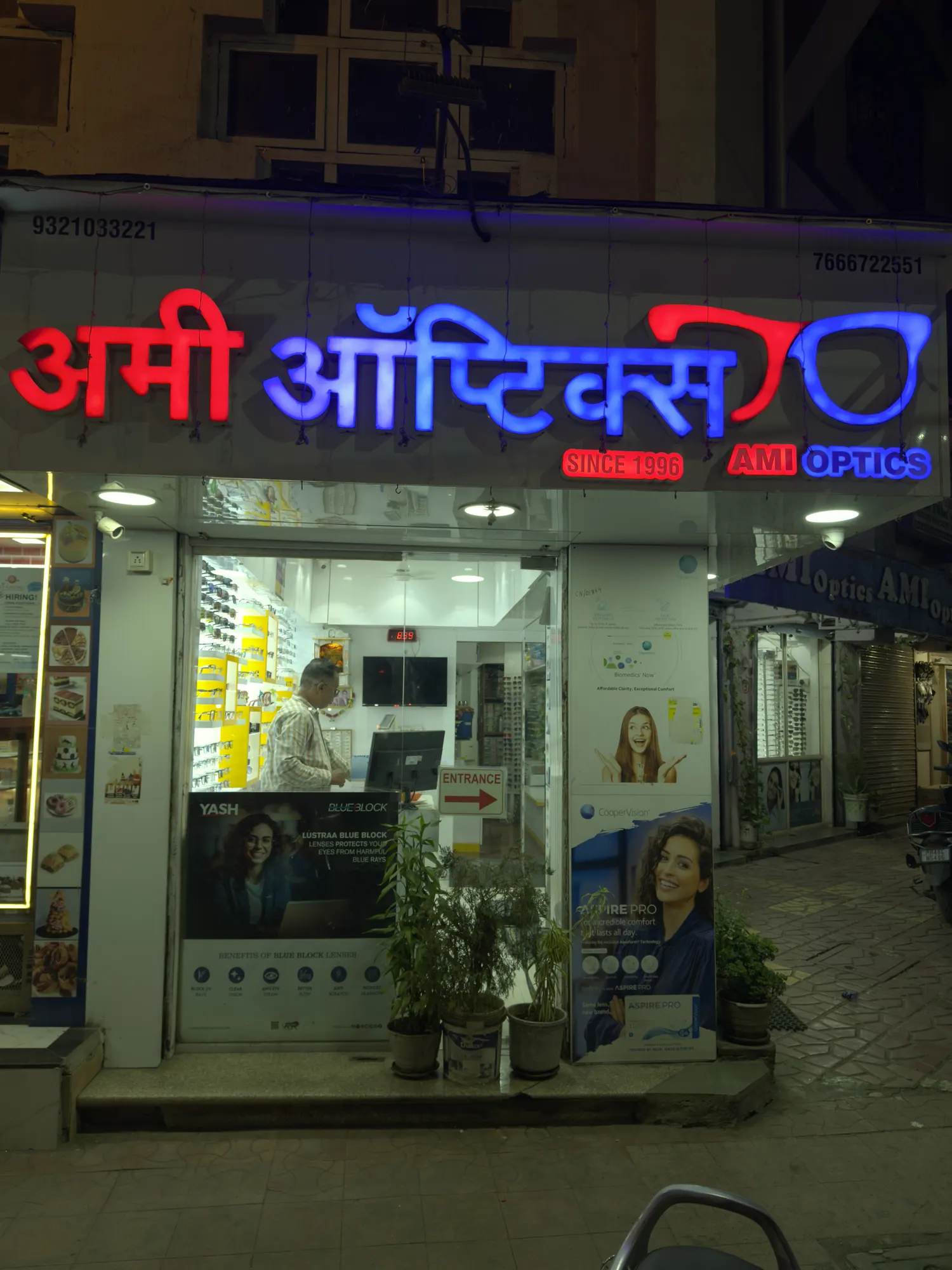
Near Sai Baba Mandir, at Jivdani Chowk.
Every guide ends the same way: come in, and we will check it against your own eyes.
Address
Ami OpticsShop No. 1, Mohan Apt., V. S. Marg
Near Sai Baba Mandir, Opp. Radha Krishna Restaurant
Virar (E), Maharashtra 401305
Hours
Mon–Thu, Sat–Sun · 9:30 am – 9:30 pm
Friday · closed
Customers come to us from Virar East, Virar West, Nalasopara and Vasai. Look for the shop opposite Radha Krishna Restaurant, near Sai Baba Mandir, at Jivdani Chowk. Landmarks and a map are on the visit us page. We speak English, हिंदी and मराठी.
Let's help you see the world clearly.
Walk in for an eye test, browse the frames, or just say hello on WhatsApp. We'd love to meet you.