Eye health · 7 min read
How to read your eye prescription
A spectacle prescription is a small grid of numbers under two rows, one for each eye, usually marked OD and OS, or RE and LE on prescriptions that write it out in English. The four columns are SPH, CYL, axis and ADD. A fifth number, PD, is often measured separately and written at the bottom or not printed at all. None of it is complicated once you know what each column is actually measuring.
Spectacle prescription
Ami Optics · Virar East
| Eye | SPH | CYL | AXIS | ADD |
|---|---|---|---|---|
| Right (OD) | −1.25 | −0.50 | 180 | +1.50 |
| Left (OS) | −1.00 | −0.75 | 170 | +1.50 |
Sample values for illustration. Minus numbers grow as short sight increases; the axis is a direction, not a strength.
- SPHSphere
The main power. A minus number corrects short sight (distance blur); a plus number corrects long sight.
- CYLCylinder
The amount of astigmatism, when the eye focuses unevenly. Blank or 0.00 means none.
- AXISAxis
The direction of that astigmatism, from 1 to 180 degrees. Only there when there is a CYL.
- ADDAddition
Extra reading power on top of the distance power. Usually appears after forty.
Got a prescription or a question about your own eyes? Send it to us on WhatsApp and we will reply with a plain answer.
Two rows, one for each eye
Every prescription has a row for the right eye and a row for the left eye, and the two are almost never identical. In India you will see this written either way: OD and OS, the Latin oculus dexter and oculus sinister that most testing machines still print, or RE and LE, right eye and left eye, which is what many local prescriptions write out instead. Same two rows either way.
Across the top, the columns are usually SPH, CYL, axis and ADD, in that order. A plain machine print-out from the autorefractor looks a little denser than the trial-frame prescription you are actually given, because the final one has already been refined on your face and rounded to a number that is comfortable, not just correct on paper.
SPH: the main power
SPH, short for sphere, is the main corrective power, measured in dioptres and written to two decimal places. A minus number, like −1.25, corrects short sight (myopia): distant things are blurred and near things are fine. A plus number, like +1.50, corrects long sight (hyperopia): it can be the opposite, or it can mean the eye is basically healthy and just needs a little help focusing up close as it ages.
The size of the number is the strength of the correction, not a verdict on how bad your eyes are. A −1.00 and a −6.00 both mean short sight; the second eye simply needs more correction to see the same chart clearly. Going up by 0.25 at a time is normal as power is refined on the trial frame; going up by a full dioptre or more between two tests, especially within a year, is the kind of change worth mentioning when you come in next.
CYL and axis: astigmatism
CYL, cylinder, is the amount of astigmatism: an eye that focuses light unevenly because the cornea is shaped a little more like a rugby ball than a football, sharp in one direction and soft in another. It is extremely common and has nothing to do with eye health; it is just a shape, corrected the same way short or long sight is.
Axis is the direction of that unevenness, written in degrees from 1 to 180. It only exists where there is a CYL, because there is nothing to point a direction at otherwise. A blank or 0.00 in the CYL column means no astigmatism was found, not a number you can ignore, and it is why that row has no axis next to it either.
ADD: reading power
ADD, addition, is extra plus power added on top of the distance power, for close work. It is what turns a distance prescription into a bifocal or a progressive, and it is almost always the same number for both eyes. It starts appearing around the early forties, as the natural lens inside the eye stiffens and near focus fades, a change called presbyopia that happens to everyone sooner or later, whether or not you already wear glasses for distance.
PD: the distance between your pupils
PD, pupillary distance, is the distance between the centres of your two pupils in millimetres. It is not a power and it does not change with your eyesight, but it decides where the optical centre of each lens sits in the frame. Get it wrong by a few millimetres and a strong lens in particular can cause a subtle pulling or eye strain that nothing on the prescription itself explains.
It is often measured separately with a ruler or a pupillometer at the time the frame is chosen, rather than printed by the autorefractor, which is why it is sometimes missing from a photographed prescription. Most adults fall somewhere between about 54 and 74 millimetres; children measure less. If you are ordering glasses anywhere that is not in front of you, this is the one number worth double-checking before the lenses are cut.
| Term | What it measures | Typical range |
|---|---|---|
| SPH | Main power: short sight (−) or long sight (+) | From about −0.25 up to double digits for very high power |
| CYL | Amount of astigmatism, if any | Blank/0.00 (none) to about −4.00 or more |
| AXIS | Direction of the astigmatism, in degrees | 1 to 180, only present if there is a CYL |
| ADD | Extra reading power on top of distance power | +0.75 to +3.00, usually after about forty |
| PD | Distance between the pupils, in millimetres | Roughly 54 to 74 mm in adults |
Reading a real example
Take the example above: the right eye (OD) reads SPH −1.25, CYL −0.50, axis 180, ADD +1.50. That is a mild degree of short sight, a small amount of astigmatism running exactly horizontal (axis 180), plus reading power for a presbyopic patient. The left eye (OS) reads −1.00, −0.75, 170, +1.50: slightly less short sight, a touch more astigmatism, the axis a little off horizontal, and the same reading addition as the other eye, which is normal since ADD rarely differs between the two.
Nothing about that pair of numbers is unusual. Most adult prescriptions in their forties and fifties look roughly like this: a small SPH, a small CYL, and an ADD that climbs gradually over the following years. What matters is not memorising the ranges but recognising your own numbers well enough to notice when one of them moves.
Computerised eye testing
How the numbers above are actually measured, and what the test costs.
Read moreThe Lens Lab
Blue cut, progressive, photochromic, high index, anti glare and polarised, each with a working demo.
Read moreProgressive vs bifocal lenses
How each one works, who suits which, and what adapting is really like.
Read more
Questions people ask
What does SPH mean on an eye prescription?
SPH, short for sphere, is the main corrective power in dioptres. A minus number corrects short sight, a plus number corrects long sight, and a larger number is a stronger power, not a worse eye.
What is the difference between SPH and CYL?
SPH is the overall power your eye needs. CYL is a separate, additional correction for astigmatism, where the eye focuses light unevenly in one direction. Many prescriptions have an SPH with no CYL at all; some need both.
Why does one eye have an axis and the other does not?
Axis is only written where there is a CYL value, because it describes the direction of astigmatism. An eye with no astigmatism has no CYL and therefore no axis, and that row is correct as it stands.
What does ADD mean on a prescription?
ADD, addition, is extra reading power added to the distance power for close work. It is usually the same figure for both eyes and typically starts appearing from the early forties as near focus naturally fades.
What is PD and why is it missing from my prescription?
PD is the distance between your pupils in millimetres, used to centre the lenses in the frame correctly. It is often measured separately when a frame is chosen rather than printed by the testing machine, which is why a photographed prescription sometimes does not show it.
Can I buy new glasses with an old prescription?
You can, but eyesight changes gradually, especially the ADD after forty, so a prescription more than one to two years old is worth rechecking first. We will tell you plainly if yours still looks right rather than sell you a test you do not need.
Is my eye prescription the same as my eye power?
People use the two terms for the same thing in everyday conversation. The prescription is the full set of numbers; the power usually refers to the SPH on its own, which is only part of the full picture if there is also a CYL and axis.
Not sure what applies to you? Ask us. A computerised eye test at the shop takes about 15 to 30 minutes, and we explain what we find in plain language.
This guide is general information from an optician, not medical advice. Sudden changes in vision, pain, flashes or a curtain over part of your sight need an eye doctor (ophthalmologist) straight away.
Find us
Near Sai Baba Mandir, at Jivdani Chowk.
Reading is a good start. A test is better. Walk in for a computerised eye test; no appointment is needed.
Address
Ami OpticsShop No. 1, Mohan Apt., V. S. Marg
Near Sai Baba Mandir, Opp. Radha Krishna Restaurant
Virar (E), Maharashtra 401305
Hours
Mon–Thu, Sat–Sun · 9:30 am – 9:30 pm
Friday · closed
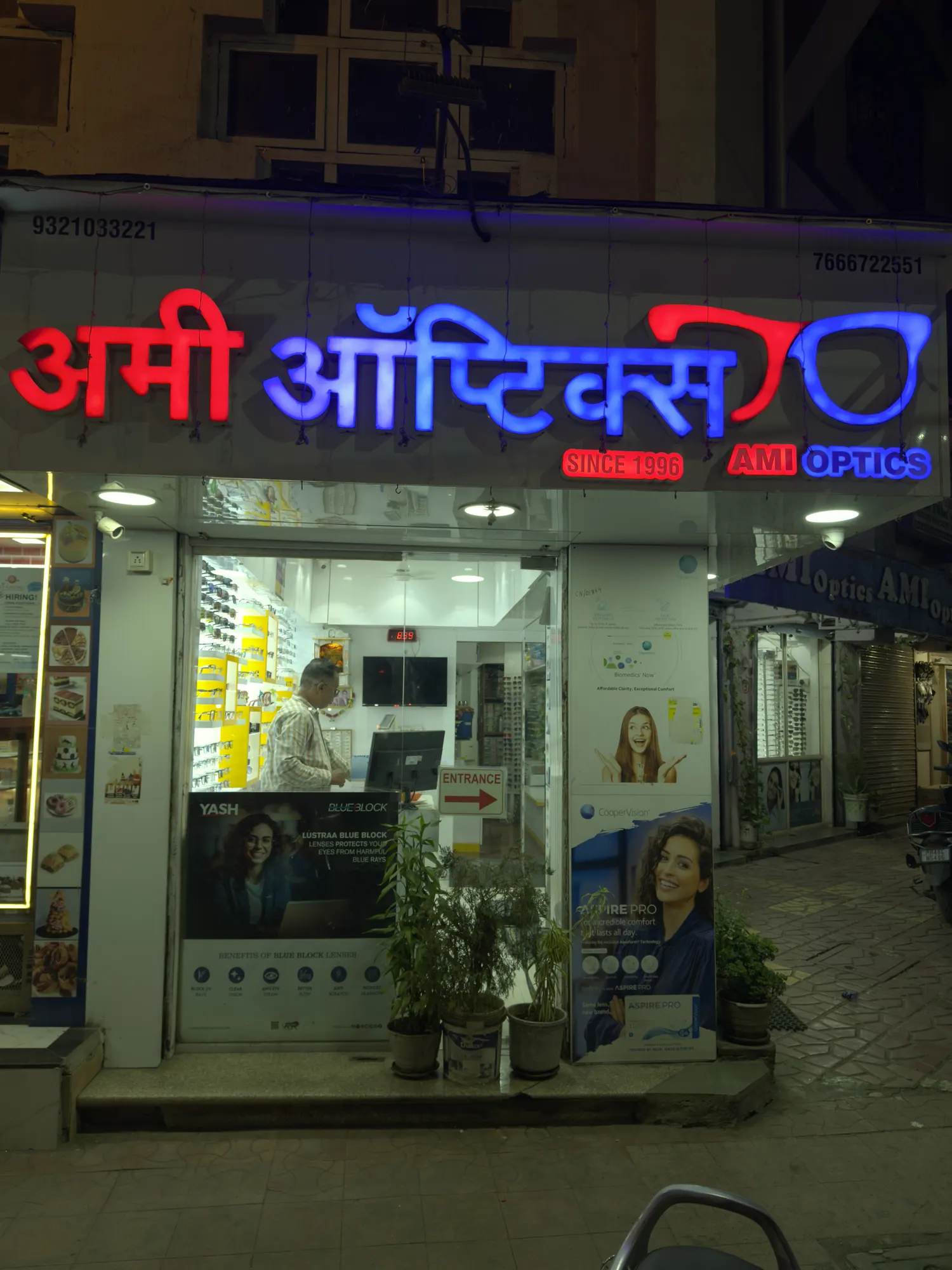
Customers come to us from Virar East, Virar West, Nalasopara and Vasai. Look for the shop opposite Radha Krishna Restaurant, near Sai Baba Mandir, at Jivdani Chowk. Landmarks and a map are on the visit us page. We speak English, हिंदी and मराठी.
Keep reading
Related guides and services
Computerised eye testing
What happens in the test, what it costs, and how to read your prescription.
Read moreThe Lens Lab
Blue cut, progressive, photochromic, high index, anti glare and polarised, each with a working demo.
Read moreSpectacles
Frames, lenses and fitting under one roof, often ready the same day.
Read moreProgressive vs bifocal lenses
How each one works, who suits which, and what adapting is really like.
Read more
Let's help you see the world clearly.
Walk in for an eye test, browse the frames, or just say hello on WhatsApp. We'd love to meet you.