
Eye health · 4 min read
How often should you get your eyes tested?
Every two years is the usual advice for adults, but the honest answer depends on your age, your health, and whether you already wear spectacles or contact lenses.
- 0 – 5Early years
At birth, around one, and before school
A paediatrician or eye doctor checks how the eyes align and develop; a lazy eye is easiest to treat young.
- 6 – 17School years
Every 1 to 2 years
Yearly if the child already wears spectacles. Power can change quickly during growth spurts.
- 18 – 39Adults
Every 2 years
Sooner if you notice a change, work long hours on screens, or wear contact lenses.
- 40 – 64Over forty
Every 1 to 2 years
Reading power (presbyopia) starts and keeps shifting; this is also when glaucoma checks matter.
- 65+Seniors
Every year
Cataract, glaucoma and macular changes are common and treatable when caught early.
These intervals follow widely used optometry guidance and are for people with no known eye disease. An ophthalmologist may ask to see you more often.
Got a prescription or a question about your own eyes? Send it to us on WhatsApp and we will reply with a plain answer.
By age
Eyes change most at the two ends of life: quickly in childhood, as the eye grows, and again from forty, when near focus fades and age-related conditions begin. The middle years are the quiet stretch, which is why the interval is longest there.
| Age | How often | Why |
|---|---|---|
| 0 to 5 | At birth, around one year, and before school | Squints and lazy eye are easiest to treat when caught early. These checks are done by a paediatrician or eye doctor. |
| 6 to 17 | Every 1 to 2 years; yearly with spectacles | Power can change quickly during growth, and schoolwork depends on it. |
| 18 to 39 | Every 2 years | The quiet years. Sooner for screens, contact lenses or symptoms. |
| 40 to 64 | Every 1 to 2 years | Reading power (presbyopia) shifts, and glaucoma and early cataract checks begin. |
| 65 and over | Every year | Cataract, glaucoma and macular changes are common, and treatable when caught early. |
When to come sooner
- Any change you notice: blur, headaches, glare at night, holding things further away.
- Diabetes or high blood pressure, which affect the small blood vessels at the back of the eye.
- A parent or sibling with glaucoma, which raises your own risk.
- Contact lens wear, which needs a periodic check of the surface of the eye as well as the power.
- A very strong prescription, which is worth monitoring more closely.
- A knock to the eye or head.
Diabetes and blood pressure
Children
A child's first checks are with a paediatrician, then before school. From then on, every one to two years, and yearly once a child wears spectacles, because growth changes the power faster than in adults. Any squint, head tilt or covering of one eye deserves a check straight away.
If you already wear spectacles or contact lenses
A yearly check keeps the prescription honest. Small changes creep in, and an old power quietly costs you comfort long before it costs you clarity. If your spectacles are more than two years old and you have not been tested, assume the power has moved.
Contact lens wearers need the surface of the eye looked at as well as the power, because a lens that has started to fit poorly rarely announces itself.
What a test involves at the shop
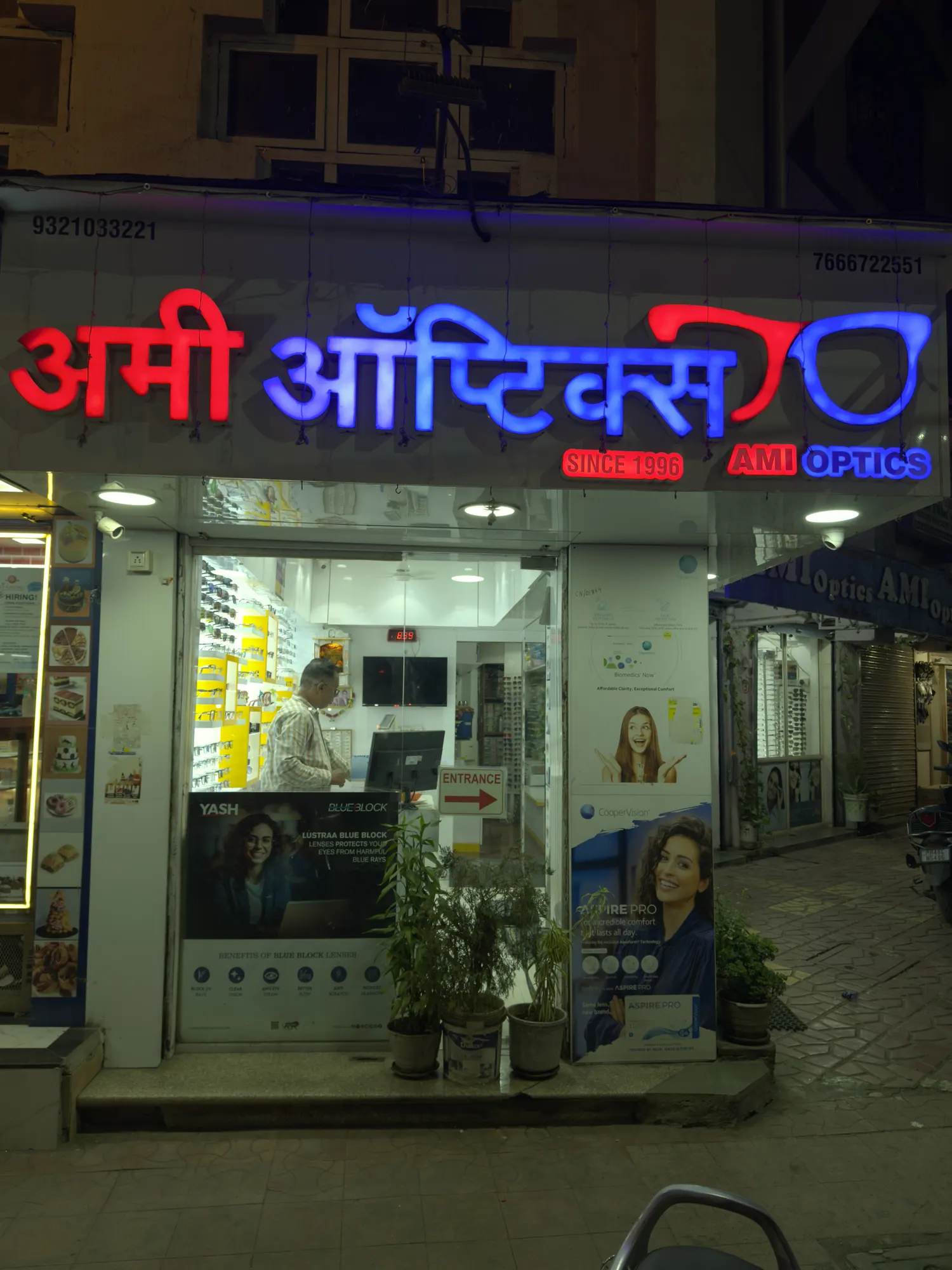
At Ami Optics in Virar East a computerised eye test takes 15 to 30 minutes, costs ₹150 (complimentary if you buy your spectacles from us), and walk-ins are welcome. Bring your current spectacles so we can measure what has changed.
Questions people ask
Is an eye test every year too often?
Not once you are over forty, wear contact lenses, have diabetes, or already wear spectacles. For a healthy adult under forty with no symptoms, every two years is fine.
Can an optician detect eye disease?
An optician's test measures how well you see and what power you need. Some problems show up along the way, and we will tell you to see a doctor when they do, but diagnosing and treating eye disease is an ophthalmologist's job.
Do I need a test if I can see fine?
Yes, on the intervals above. Glaucoma and diabetic changes have no early symptoms, and small powers hide behind extra focusing effort that shows up as tiredness rather than blur.
How often should contact lens wearers be checked?
Every year, even if the lenses feel fine, so the fit and the health of the eye's surface can be checked along with the power.
Not sure what applies to you? Ask us. A computerised eye test at the shop takes about 15 to 30 minutes, and we explain what we find in plain language.
This guide is general information from an optician, not medical advice. Sudden changes in vision, pain, flashes or a curtain over part of your sight need an eye doctor (ophthalmologist) straight away.
Find us
Near Sai Baba Mandir, at Jivdani Chowk.
Reading is a good start. A test is better. Walk in for a computerised eye test; no appointment is needed.
Address
Ami OpticsShop No. 1, Mohan Apt., V. S. Marg
Near Sai Baba Mandir, Opp. Radha Krishna Restaurant
Virar (E), Maharashtra 401305
Hours
Mon–Thu, Sat–Sun · 9:30 am – 9:30 pm
Friday · closed
Customers come to us from Virar East, Virar West, Nalasopara and Vasai. Look for the shop opposite Radha Krishna Restaurant, near Sai Baba Mandir, at Jivdani Chowk. Landmarks and a map are on the visit us page. We speak English, हिंदी and मराठी.
Keep reading
Related guides and services
Computerised eye testing
What happens in the test, what it costs, and how to read your prescription.
Read moreSigns you need an eye test
Headaches, screen blur, night driving: the everyday signs that your power has changed.
Read moreKids eye test
Gentle testing for children, and frames built for school days.
Read moreContact lenses
Daily, monthly, toric, multifocal and colour lenses, with patient help for first-time wearers.
Read more
Let's help you see the world clearly.
Walk in for an eye test, browse the frames, or just say hello on WhatsApp. We'd love to meet you.