Eye health · 5 min read
Signs you need an eye test
Most people wait until they cannot read a sign. The earlier signs are quieter: headaches by evening, screens that blur, holding the phone a little further away each month. Here is what to watch for, and when it is a doctor rather than an optician.
Blurry after screen time
Distance looks soft when you look up from the laptop, and takes a moment to sharpen.
Headaches by evening
A dull ache across the forehead or behind the eyes on long reading or screen days.
Holding things further away
Menus and messages are clearer at arm's length. After forty, this is usually presbyopia.
Night driving feels harder
Halos around headlights and difficulty reading signs are often an uncorrected power or astigmatism.
Tired, dry or watery eyes
Eyes that ache or water after concentration, even with no obvious blur.
Squinting to read
If you narrow your eyes to sharpen text or faces, your eyes are doing work a lens should do.
Got a prescription or a question about your own eyes? Send it to us on WhatsApp and we will reply with a plain answer.
Your eyes do not fail loudly
A small change in power is easy to hide from yourself. You squint a little, the focusing muscle inside the eye works a little harder, and you hold things where they look clearest. The strain shows up somewhere else: a tired feeling behind the eyes, a headache across the forehead, a reluctance to read in the evening.
That is why the signs below are worth taking seriously even when you can still, technically, see. An eye test at the shop takes 15 to 30 minutes, and the most common outcome is a small correction that makes the evenings easier.
Blur and tiredness after screens
If distance looks soft when you look up from a laptop and takes a moment to sharpen, your focusing muscle has been locked at one distance for too long. Everyone gets some of this. If it happens daily, or comes with dry, gritty eyes, there is often a small uncorrected power or astigmatism underneath it that a test will find.
Blue cut lenses help many screen users feel more comfortable, but they do not fix strain that comes from a wrong power. We check the power first.
Headaches by evening
A dull ache across the forehead or behind the eyes on long reading or screen days is one of the classic signs, especially in people who have never worn spectacles. It comes from the effort of focusing through an error the eye is trying to correct on its own.
Not every headache is your eyes. A headache with nausea, a visual aura, or one that wakes you at night needs a doctor. But if the pattern is tied to close work and eases at the weekend, a test is the place to start.
Holding things further away
Somewhere between forty and forty-five, the lens inside the eye stiffens and near focus fades. Menus move to arm's length, the phone font gets bigger, and reading in dim light becomes a chore. This is presbyopia, and it happens to everyone.
The fix is reading power: a simple reading pair, or a progressive lens that keeps distance, screen and reading in one pair. Both are explained in the Lens Lab.
Night driving feels harder
Halos around oncoming headlights, glare from streetlights and difficulty reading signs at night are often the first sign of a small power or astigmatism that the eye copes with in daylight. An anti glare coating on the right power makes a striking difference.
In older adults the same symptoms can also be an early cataract, which is a doctor's diagnosis. If a test shows that spectacles will not fix the glare, we will tell you and point you to an ophthalmologist.
Signs in children
Children rarely complain, because blurry is all they have known. Watch for sitting close to the TV, squinting, rubbing the eyes, tilting the head, losing the place while reading, and headaches after school. Our kids eye test page goes through each of them, and what a child's test is like.
Kids eye test
Gentle testing for children, and frames built for school days.
Read moreWhy more children need spectacles today
The rising-myopia trend, the signs worth a check, and what genuinely helps.
Read moreScreen time and eye strain
Why screens tire your eyes, what actually helps, and where lenses fit in.
Read more
When it is a doctor, not an optician
What a test involves
Autorefractor reading
You look at a picture inside the machine while it measures how your eye focuses light. A starting point, not the final number.
About 2 minutesRefined on a trial frame
Lenses are swapped in a trial frame while you read the chart. Your answers fine-tune the power, one step at a time.
10 to 20 minutesYour prescription, explained
You get the numbers, what they mean, and an honest view on whether you need new spectacles at all.
Same visitAt the shop a computerised eye test takes 15 to 30 minutes and costs ₹150, complimentary with a spectacles purchase: an autorefractor reading, refined on a trial frame until the chart is sharp and comfortable, then the prescription explained in plain language. Walk-ins are welcome.
Questions people ask
Can I need spectacles even if I can see clearly?
Yes. A small power, particularly astigmatism or long sight, is often hidden by the focusing muscle working harder. You see clearly but pay for it in tiredness and headaches. A test shows whether that is the case.
Should I get an eye test for headaches?
If the headaches come after reading, screens or a long day of focusing, yes: an uncorrected power or a change in an old one is a common cause, and the test is quick. If they are sudden, severe, one-sided, or come with nausea or changes in vision, see a doctor first.
Do headaches always mean I need glasses?
No. Headaches tied to reading and screens, easing at weekends, often do. Headaches with nausea, visual aura, or that wake you at night need a doctor first.
How often should I be tested if I have no symptoms?
Every two years for adults under forty, every one to two years from forty, and yearly after 65. Sooner if you have diabetes, a family history of glaucoma, or wear contact lenses.
Is blur after screen time dangerous?
Usually not; it is the focusing muscle recovering. If it happens every day, or with dry eyes and headaches, a test often finds a small power that is making it worse.
Not sure what applies to you? Ask us. A computerised eye test at the shop takes about 15 to 30 minutes, and we explain what we find in plain language.
This guide is general information from an optician, not medical advice. Sudden changes in vision, pain, flashes or a curtain over part of your sight need an eye doctor (ophthalmologist) straight away.
Find us
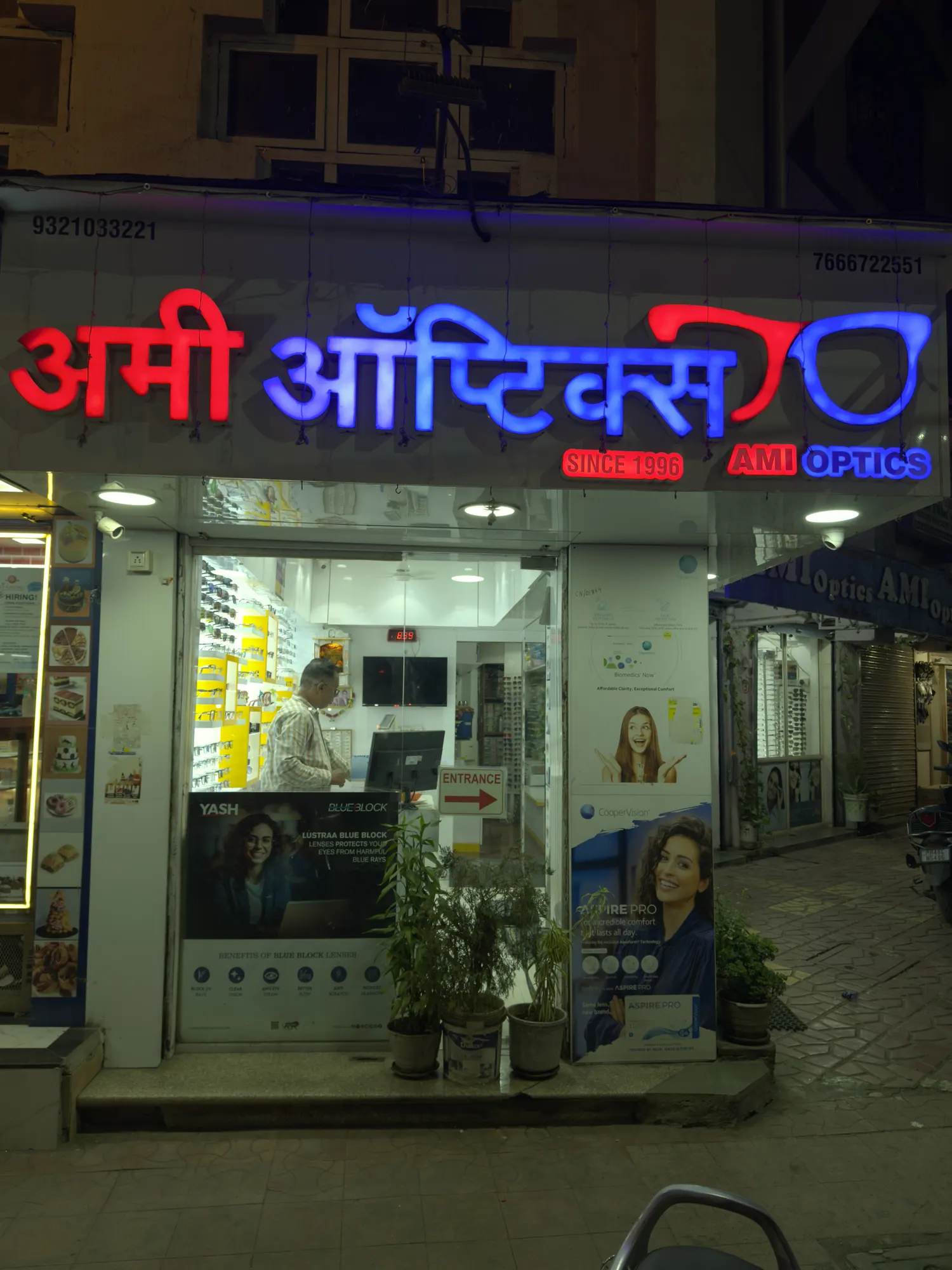
Near Sai Baba Mandir, at Jivdani Chowk.
Reading is a good start. A test is better. Walk in for a computerised eye test; no appointment is needed.
Address
Ami OpticsShop No. 1, Mohan Apt., V. S. Marg
Near Sai Baba Mandir, Opp. Radha Krishna Restaurant
Virar (E), Maharashtra 401305
Hours
Mon–Thu, Sat–Sun · 9:30 am – 9:30 pm
Friday · closed
Customers come to us from Virar East, Virar West, Nalasopara and Vasai. Look for the shop opposite Radha Krishna Restaurant, near Sai Baba Mandir, at Jivdani Chowk. Landmarks and a map are on the visit us page. We speak English, हिंदी and मराठी.
Keep reading
Related guides and services
How to check your eye power at home
A two-minute check for blurry vision, and what only a proper test can tell you.
Read moreComputerised eye testing
What happens in the test, what it costs, and how to read your prescription.
Read moreHow often to get your eyes tested
By age, and the situations that call for a sooner check.
Read moreScreen time and eye strain
Why screens tire your eyes, what actually helps, and where lenses fit in.
Read moreThe Lens Lab
Blue cut, progressive, photochromic, high index, anti glare and polarised, each with a working demo.
Read more
Let's help you see the world clearly.
Walk in for an eye test, browse the frames, or just say hello on WhatsApp. We'd love to meet you.