
Eye health · 5 min read
Screen time and eye strain
Tired, dry, blurry eyes at the end of a screen day are so common they have a name: digital eye strain. Most of it comes from three things you can change, and one thing an eye test finds.
Every 20 minutes, look at something about 20 feet (6 metres) away for 20 seconds. It lets the focusing muscle relax and reminds you to blink.
- Blink fully and often; screens roughly halve your blink rate.
- Match screen brightness to the room and keep windows to the side, not behind or in front.
- Make text bigger rather than leaning in.
Got a prescription or a question about your own eyes? Send it to us on WhatsApp and we will reply with a plain answer.
Why screens tire your eyes
Two things happen at a screen. First, you blink about half as often as usual, so the tear film dries and the surface of the eye gets gritty and red. Second, the focusing muscle inside the eye holds one distance for hours without the natural resting glances at the horizon that reading a book or working with your hands gives you.
Add a small uncorrected power, a screen that is too close, too high or too bright, and text that is too small, and the eye is working hard all day. The result is the familiar evening: dry eyes, a dull headache, distance that takes a moment to sharpen when you look up.
Set up your screen
- Distance: 50 to 70 centimetres, about an arm's length. Closer makes the focusing muscle work harder.
- Height: the top of the screen at or just below eye level, so you look slightly down. Looking up opens the eye wider and dries it faster.
- Tilt the screen back 10 to 20 degrees to cut reflections from lights above.
- Brightness to match the room, and no window directly behind or in front of the screen.
- Text large enough to read without leaning in. Zoom is free.
- A laptop on a desk puts the screen too low. A stand or a stack of books, plus a separate keyboard, fixes it.
Habits that help
20 · 20 · 20
Every 20 minutes, look at something about 20 feet away for 20 seconds. Set a timer for a week and it becomes a habit.
Blink on purpose
Full, slow blinks when you notice your eyes feel dry. Lubricating drops help if the room is air-conditioned.
Take real breaks
A few minutes away from every screen, phone included, once an hour. Stepping outside resets distance focus.
Where lenses come in
The most useful lens for screen strain is simply the right power. A small astigmatism or a mild long sight that the eye copes with in daily life becomes a burden at a screen, and correcting it is often the single biggest relief. An anti glare coating cuts reflections from lights and the screen itself.
After forty, an ordinary reading pair is the wrong distance for a monitor, and a progressive lens gives only a narrow corridor for the screen. For people who spend most of the day at a desk, an office or computer lens made for the screen distance is worth asking about.
Blue cut lenses filter some of the blue light screens give off, and many wearers say long screen days feel easier through them. They are a reasonable choice for heavy screen users. They do not fix strain that comes from a wrong power, from not blinking, or from a screen set up badly, so we check those first and say so.
Blue cut lenses in the Lens Lab
What the filter does, who it suits, and where it falls short, with a demo.
Read moreAnti glare lenses
Reflections cleared off the lens for screens, video calls and night driving.
Read moreAnti-glare vs blue light filter
Two different coatings, what each one actually changes, and whether you need both.
Read more
Children and screens
Children's eyes are still developing, and long hours of close work at a screen are linked with short sight increasing faster during the growing years. The same setup rules apply, with two more: time outdoors every day, which is protective, and a yearly eye test once a child wears spectacles.
When to get tested
- Blur or tiredness after screens most days, despite breaks.
- Headaches by the afternoon on work days that ease at the weekend.
- Double vision, or letters that swim, at the screen.
- Dry, red eyes that drops do not settle.
- It has been more than two years since your last test.
Autorefractor reading
You look at a picture inside the machine while it measures how your eye focuses light. A starting point, not the final number.
About 2 minutesRefined on a trial frame
Lenses are swapped in a trial frame while you read the chart. Your answers fine-tune the power, one step at a time.
10 to 20 minutesYour prescription, explained
You get the numbers, what they mean, and an honest view on whether you need new spectacles at all.
Same visitQuestions people ask
Do blue cut lenses stop eye strain?
They filter part of the blue light from screens and many people find long screen days more comfortable through them. They do not fix strain from a wrong power, from not blinking, or from a badly set up screen, so those come first.
Which lens is best for computer work?
The right power with an anti glare coating, first. Blue cut is a reasonable addition for heavy screen users. After forty, a dedicated office lens made for the screen distance is often better than a reading pair or a progressive alone.
Can screens permanently damage my eyes?
There is no good evidence that screen light damages adult eyes. The strain is real but temporary. In children, long hours of close work are linked with faster increases in short sight, which is why outdoor time matters.
Why do my eyes feel dry at a computer?
You blink about half as often at a screen, so the tear film dries out. Deliberate full blinks, a screen set slightly below eye level, and lubricating drops in air-conditioned rooms all help.
Not sure what applies to you? Ask us. A computerised eye test at the shop takes about 15 to 30 minutes, and we explain what we find in plain language.
This guide is general information from an optician, not medical advice. Sudden changes in vision, pain, flashes or a curtain over part of your sight need an eye doctor (ophthalmologist) straight away.
Find us
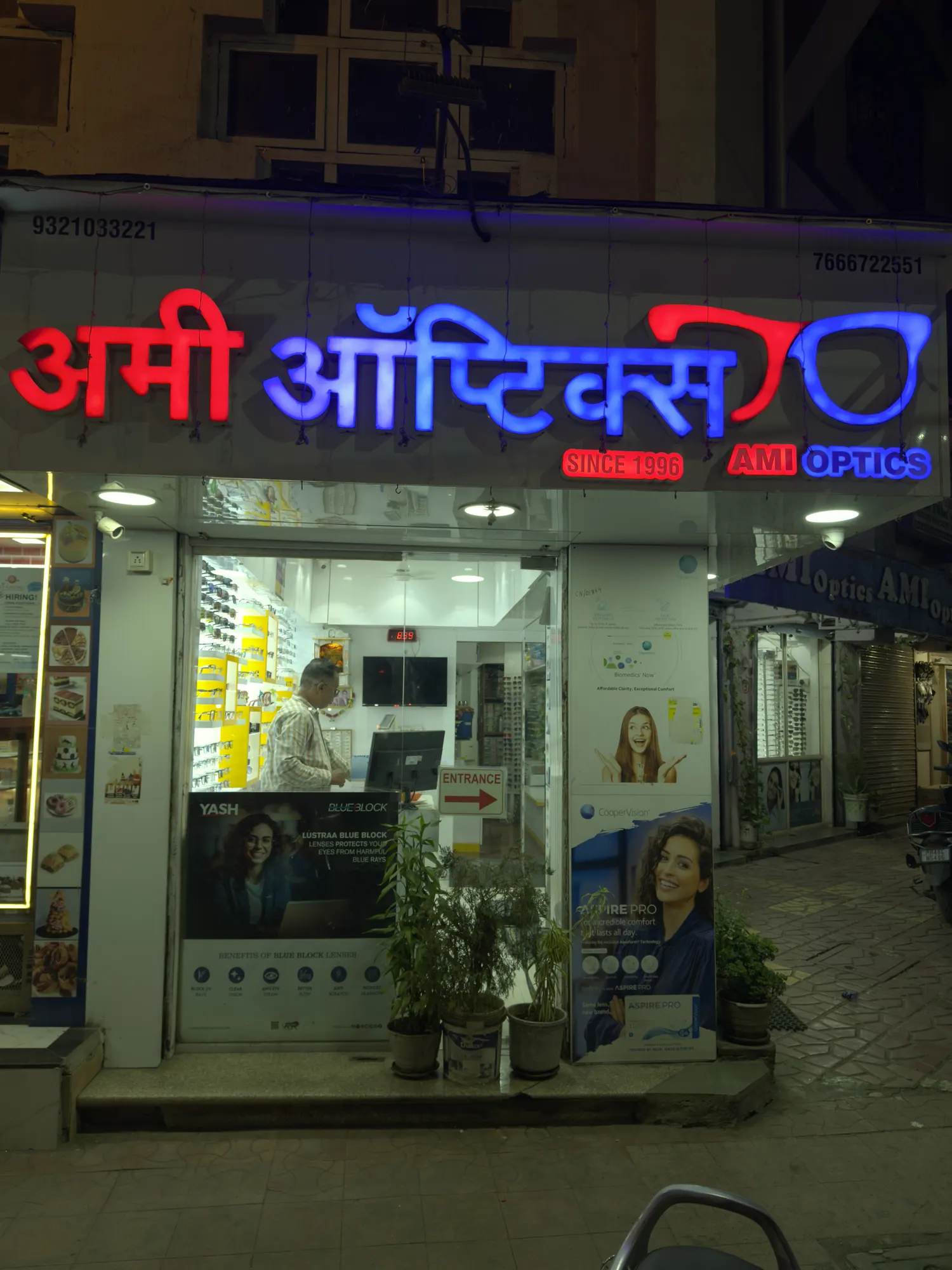
Near Sai Baba Mandir, at Jivdani Chowk.
Reading is a good start. A test is better. Walk in for a computerised eye test; no appointment is needed.
Address
Ami OpticsShop No. 1, Mohan Apt., V. S. Marg
Near Sai Baba Mandir, Opp. Radha Krishna Restaurant
Virar (E), Maharashtra 401305
Hours
Mon–Thu, Sat–Sun · 9:30 am – 9:30 pm
Friday · closed
Customers come to us from Virar East, Virar West, Nalasopara and Vasai. Look for the shop opposite Radha Krishna Restaurant, near Sai Baba Mandir, at Jivdani Chowk. Landmarks and a map are on the visit us page. We speak English, हिंदी and मराठी.
Keep reading
Related guides and services
Computerised eye testing
What happens in the test, what it costs, and how to read your prescription.
Read moreThe Lens Lab
Blue cut, progressive, photochromic, high index, anti glare and polarised, each with a working demo.
Read moreSigns you need an eye test
Headaches, screen blur, night driving: the everyday signs that your power has changed.
Read moreProgressive vs bifocal lenses
How each one works, who suits which, and what adapting is really like.
Read more
Let's help you see the world clearly.
Walk in for an eye test, browse the frames, or just say hello on WhatsApp. We'd love to meet you.