Lenses · 6 min read
Anti-glare coating vs blue light filter
They get sold in the same breath, so it is easy to assume they do the same job. They do not. Anti-glare is a coating on the lens surface that clears reflections, mainly for night driving and bright light. A blue light filter is built into the lens material itself and cuts the specific wavelengths screens give off. A lens can carry one, the other, or both.
Clears surface reflections
Cuts the halos and glare off both faces of the lens, so more light reaches your eye, not less.
Built for night driving and bright light
Oncoming headlights, overhead shop lighting, a bright window behind a video call.
A coating, so it can wear
Lasts the life of the lens with a proper lens cloth; a dry wipe with a tissue is what scratches it.
Cuts screen blue light
Built into the lens material itself, so it cannot be added afterwards to lenses you already own.
Made for long sessions
Takes the edge off hours on a laptop or phone. It will not fix strain that comes from an outdated power.
Works at any power, including none
People with no correction wear it too, in a plain zero-power lens, for screen comfort alone.
Different jobs, not rival products. Many lenses carry both, and we will say plainly which your prescription and your day actually need.
Got a prescription or a question about your own eyes? Send it to us on WhatsApp and we will reply with a plain answer.
Why the two get mixed up
Both get pitched around the same complaint: tired eyes after a long day of screens, driving or both. Both are invisible once the lens is made, so there is nothing to point at and compare. And both often sit inside the same premium lens package at the counter, which makes them feel like one upgrade rather than two separate ones.
They are separate because they solve separate physical problems. One is about light bouncing off the lens before it reaches your eye. The other is about which wavelengths of light get through the lens at all.
What anti-glare coating actually does
Every lens surface reflects a small amount of the light that hits it, on both faces. You notice it as a faint ghost image in a photograph, a halo around headlights at night, or a wash of light across your lenses on a video call. An anti-glare (also called anti-reflective) coating is a microscopically thin layer added to the surface that cancels out most of that reflected light, so more of it passes through to your eye instead of bouncing back.
The difference shows up most at night and in bright, uneven light: oncoming headlights on a dark road, fluorescent tube lighting indoors, a bright window behind someone on a call. Most coatings now also resist smudges and water, so the lens stays cleaner for longer. It is standard on most lenses sold today because the improvement is immediate and has nothing to do with screens specifically.
What a blue light filter actually does
Screens and LED lighting give off more of the blue end of the visible spectrum than older incandescent light did. A blue light filter, sometimes sold as blue cut, is blended into the lens material itself rather than coated on afterward, and it reduces how much of that blue-toned light reaches your eye.
What it changes, honestly: many people who spend long stretches on a laptop or phone say the screen feels easier on the eyes with it, and some lenses carry a faint tint as a result. What it will not do is fix eye strain that is actually caused by a wrong or outdated power, poor screen distance, or not blinking enough while concentrating, so we check those first before suggesting the filter as the answer on its own.
| Anti-glare coating | Blue light filter | |
|---|---|---|
| Where it sits | A coating on the lens surface | Built into the lens material |
| What it changes | Reflections bouncing off the lens | Blue-toned wavelengths passing through it |
| Helps most with | Night driving, bright or fluorescent light, video calls | Long stretches on a screen |
| Needs a prescription? | No, works on plain zero-power lenses too | No, same as anti-glare |
| Add to existing lenses? | Often yes, on a reglaze | No, it has to be made into a new lens |
| Wears off? | The coating can if cleaned with a dry cloth or tissue | No, it does not wear off; it is part of the lens |
Do you need one, the other, or both
Anti-glare alone
You drive after dark, or sit under harsh light
- Oncoming headlights bother you on night drives
- You work under fluorescent or overhead office lighting
- You are on video calls often and dislike the glare across your lenses
- You do not spend unusually long hours on a screen
Blue light filter alone
Mostly screens, not much night driving
- Most of your day is spent on a laptop or phone
- Your eyes feel tired by evening after screen-heavy work
- Night driving is rare for you
- You already have an older pair with anti-glare that still does its job
Both together
The common choice for office workers
- Long screen hours and some night driving, in the same week
- You want one pair that covers most situations without thinking about it
- You are due for a new lens anyway, so adding both costs little extra over adding one later
- We will still check your power and screen setup first; a coating is not a fix for either
Questions people ask
Is anti-glare coating the same as a blue light filter?
No. Anti-glare clears reflections off the lens surface, which mainly helps with night driving and bright or fluorescent light. A blue light filter cuts blue-toned wavelengths from screens and is built into the lens material. Some lenses carry both.
Do I need both anti-glare and blue light coatings?
Only if your day genuinely includes both triggers: long screen hours and night driving or bright, glary light. If you only have one of those, one coating usually covers it, and we will say so rather than sell you both automatically.
Do blue light glasses actually reduce eye strain?
Many people who spend long hours on a screen find it more comfortable. It will not fix strain caused by a wrong power, poor screen distance, or not blinking enough, so those are checked first rather than assumed to be a coating problem.
How can I check if my lenses have anti-glare coating?
Hold the spectacles under a light and look at the reflection on the lens. An anti-glare lens shows a faint, coloured reflection, usually green, blue or purple, and you can see through it easily. An uncoated lens throws back a bright white reflection of the light. A blue light filter lens often shows a stronger blue reflection on top.
Can anti-glare coating be added to glasses I already own?
Usually yes, by reglazing the lenses (remaking them in the same frame), though it is simplest and cheapest to add when a new lens is made. A blue light filter cannot be added afterwards either way, since it has to be part of the lens material from the start.
Does anti-glare coating wear off over time?
A good coating lasts the life of the lens with proper care: clean it with a lens cloth and lens spray, not a tissue or a shirt. Wiping dry lenses with rough cloth is what scratches the coating over time.
Which coating helps more with night driving?
Anti-glare. It clears the reflections that cause halos around headlights. A blue light filter is built for screen comfort and makes little difference to night driving glare on its own.
Are blue light filter lenses only useful for computer work?
They are built for screens specifically, but plenty of people wear them with a plain, zero-power lens purely for comfort during long phone or laptop sessions, prescription or not.
Not sure what applies to you? Ask us. A computerised eye test at the shop takes about 15 to 30 minutes, and we explain what we find in plain language.
This guide is general information from an optician, not medical advice. Sudden changes in vision, pain, flashes or a curtain over part of your sight need an eye doctor (ophthalmologist) straight away.
Find us
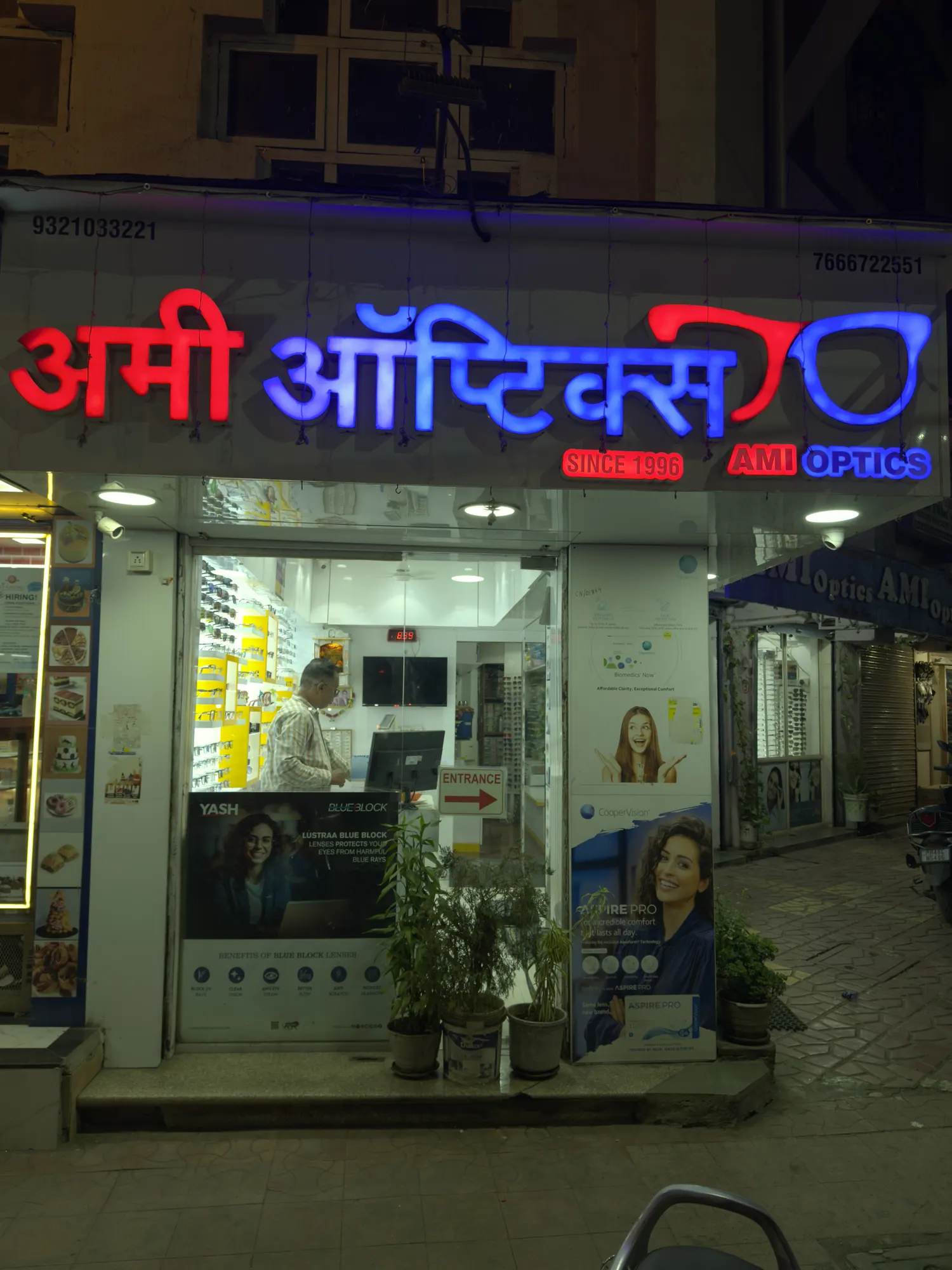
Near Sai Baba Mandir, at Jivdani Chowk.
Reading is a good start. A test is better. Walk in for a computerised eye test; no appointment is needed.
Address
Ami OpticsShop No. 1, Mohan Apt., V. S. Marg
Near Sai Baba Mandir, Opp. Radha Krishna Restaurant
Virar (E), Maharashtra 401305
Hours
Mon–Thu, Sat–Sun · 9:30 am – 9:30 pm
Friday · closed
Customers come to us from Virar East, Virar West, Nalasopara and Vasai. Look for the shop opposite Radha Krishna Restaurant, near Sai Baba Mandir, at Jivdani Chowk. Landmarks and a map are on the visit us page. We speak English, हिंदी and मराठी.
Keep reading
Related guides and services
The Lens Lab
Blue cut, progressive, photochromic, high index, anti glare and polarised, each with a working demo.
Read moreScreen time and eye strain
Why screens tire your eyes, what actually helps, and where lenses fit in.
Read moreSpectacles
Frames, lenses and fitting under one roof, often ready the same day.
Read moreComputerised eye testing
What happens in the test, what it costs, and how to read your prescription.
Read more
Let's help you see the world clearly.
Walk in for an eye test, browse the frames, or just say hello on WhatsApp. We'd love to meet you.