Eye health · 5 min read
Why more children need spectacles today
A generation ago, a child in spectacles stood out in a classroom photo. That is changing fast, and screens are only part of the reason. Here is what is actually shifting, what parents notice first, and what genuinely helps.
Sitting very close to the TV
Or holding a phone or book unusually near the face. The classic sign of short sight.
Squinting or frowning to see
Narrowing the eyes sharpens a blurry image for a moment. Watch for it at the board or the TV.
Rubbing the eyes often
Especially after reading or homework, and not only when tired.
Tilting or turning the head
Looking at things from an angle, or covering one eye, can mean the two eyes are not working together.
Headaches after school
Frontal headaches or tired eyes by evening, particularly on heavy reading days.
Losing the place when reading
Skipping lines, using a finger to track, or avoiding reading altogether.
Got a prescription or a question about your own eyes? Send it to us on WhatsApp and we will reply with a plain answer.
A quiet shift in the classroom
Walk into any classroom today and you will see more children in spectacles than a generation ago. This is not really about phones or any one gadget. Eye researchers in India have been tracking a real, steady rise in short sight among children in cities for more than two decades, roughly one child in twenty back in the late 1990s, closer to one in five now, and the trend is not expected to flatten out on its own.
None of this means every child is destined for thick spectacles. It means the odds of a child needing a test, and needing it sooner than you might expect, are higher than they used to be.
What is actually changing
The two factors eye doctors point to most consistently are more time spent on close-up work, reading, homework and screens together, and less time spent outdoors in daylight. Neither one is a single villain. A child doing an hour of screen time outdoors in the evening light is in a different position from one doing three hours indoors after school with no break.
This does not mean screens are forbidden or that homework is the enemy. It means the balance between near work and outdoor time has shifted for most children, and eyes tend to grow to suit the distance they focus at most.
Sitting very close to the TV
Or holding a phone or book unusually near the face. The classic sign of short sight.
Squinting or frowning to see
Narrowing the eyes sharpens a blurry image for a moment. Watch for it at the board or the TV.
Rubbing the eyes often
Especially after reading or homework, and not only when tired.
Tilting or turning the head
Looking at things from an angle, or covering one eye, can mean the two eyes are not working together.
Headaches after school
Frontal headaches or tired eyes by evening, particularly on heavy reading days.
Losing the place when reading
Skipping lines, using a finger to track, or avoiding reading altogether.
What actually gets noticed first
- Sitting closer to the TV, or holding books and phones close to the face
- Squinting to see the board at school or a sign at a distance
- A drop in reading or schoolwork that was fine before
- Complaining of tired eyes or headaches after school
- Rubbing the eyes often, or blinking a lot with no obvious reason
Our full guide to the signs of needing an eye test goes through each of these in more detail, for children and adults alike. None of them confirms anything on its own; a test is the only way to know.
Two worries most parents have
The first is that spectacles will make a child's eyes lazy or dependent, so the power will just keep getting worse. That is not how it works. An uncorrected eye does not rest, it strains, and a correctly prescribed pair simply lets your child see clearly at their current power. What happens to that power over the following years has far more to do with age and the factors above than with wearing the correction.
The second worry is that a rising power as a child grows means something has gone wrong. In most children, power does shift through the growing years and settles down by the late teens, which is exactly why regular testing matters more than any single result. A test that finds a small increase is doing its job, not delivering bad news.
What genuinely seems to help
- More time outdoors in daylight, even just being outside, not necessarily sport
- Regular breaks from continuous close-up screen or homework time
- A comfortable reading distance and enough light, rather than reading close-up in the dark
- Testing on schedule, so a change is caught and corrected quickly instead of left to grow
Our screen time and eye strain guide goes further into the second point, including the break habit we recommend most.
When to get a test
Before a child starts school if possible, then every one to two years, and yearly once they wear spectacles, since power can change quickly during growth. A squint, a head tilt or covering one eye deserves a check straight away rather than waiting for the next scheduled test. Our kids eye test page has the detail on what the test itself is like.
Questions people ask
Is myopia in children actually increasing, or does it just seem that way?
It is a genuine, long-tracked trend, not a perception. Research on urban Indian children has shown the share with short sight rising steadily over the last two decades, and eye doctors expect it to keep climbing for now. It varies a great deal by child, but the direction is real.
Does screen time actually cause it?
Screens are one part of a bigger shift: more near work overall and less time outdoors, not a single cause on their own. Cutting screens to zero will not undo it, but regular breaks and more outdoor time are genuinely worth building in.
Will my child's power keep getting worse every year?
Power often does shift during the growing years and typically settles by the late teens. That is exactly why we test yearly once a child wears spectacles: small, expected changes are corrected as they happen rather than left to build up.
Do spectacles make a child's eyes weaker or dependent on them?
No. This is one of the most common worries, and it is a myth. A correctly prescribed pair simply lets your child see clearly at their current power. Leaving a real power uncorrected is what causes strain, not the spectacles.
What should I do if I notice one of the signs?
Book a test rather than wait it out. It takes 15 to 30 minutes, is not uncomfortable, and if nothing is wrong we will say so plainly.
Not sure what applies to you? Ask us. A computerised eye test at the shop takes about 15 to 30 minutes, and we explain what we find in plain language.
This guide is general information from an optician, not medical advice. Sudden changes in vision, pain, flashes or a curtain over part of your sight need an eye doctor (ophthalmologist) straight away.
Find us
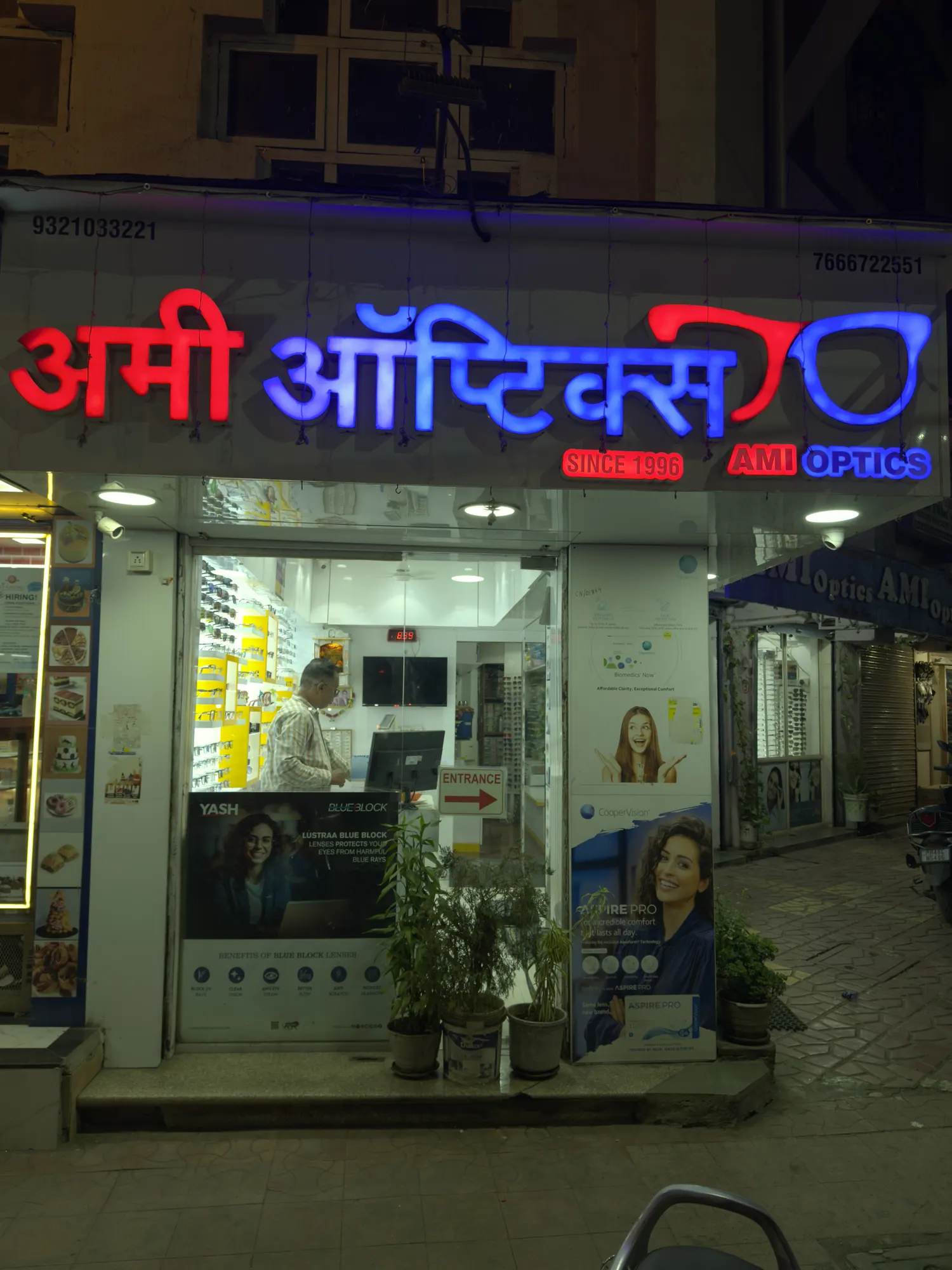
Near Sai Baba Mandir, at Jivdani Chowk.
Reading is a good start. A test is better. Walk in for a computerised eye test; no appointment is needed.
Address
Ami OpticsShop No. 1, Mohan Apt., V. S. Marg
Near Sai Baba Mandir, Opp. Radha Krishna Restaurant
Virar (E), Maharashtra 401305
Hours
Mon–Thu, Sat–Sun · 9:30 am – 9:30 pm
Friday · closed
Customers come to us from Virar East, Virar West, Nalasopara and Vasai. Look for the shop opposite Radha Krishna Restaurant, near Sai Baba Mandir, at Jivdani Chowk. Landmarks and a map are on the visit us page. We speak English, हिंदी and मराठी.
Keep reading
Related guides and services
Kids eye test
Gentle testing for children, and frames built for school days.
Read moreSigns you need an eye test
Headaches, screen blur, night driving: the everyday signs that your power has changed.
Read moreScreen time and eye strain
Why screens tire your eyes, what actually helps, and where lenses fit in.
Read moreHow often to get your eyes tested
By age, and the situations that call for a sooner check.
Read more
Let's help you see the world clearly.
Walk in for an eye test, browse the frames, or just say hello on WhatsApp. We'd love to meet you.