Frames · 5 min read
Which frame suits your face shape?
Face shape is a useful starting point and a terrible rule. Use it to narrow a wall of frames down to a handful, then let fit, comfort and your prescription decide.
- Oval
Try Almost anything. Keep the frame as wide as the face.
Avoid Frames much wider than the cheekbones.
- Round
Try Rectangular or angular frames to add definition.
Avoid Small round frames that echo the face.
- Square
Try Round or oval frames to soften the jaw.
Avoid Boxy, sharp-cornered frames.
- Heart
Try Frames that are wider at the bottom, rimless or light round shapes.
Avoid Heavy top bars and decorated temples.
- Oblong
Try Deeper, taller frames and a low bridge to shorten the face.
Avoid Narrow, shallow frames.
- Diamond
Try Cat-eye, oval or rimless frames that draw the eye upward.
Avoid Narrow frames that emphasise the cheekbones.
Got a prescription or a question about your own eyes? Send it to us on WhatsApp and we will reply with a plain answer.
Find your face shape
Pull your hair back and look straight into a mirror. Notice three widths, forehead, cheekbones and jaw, and the length of the face from hairline to chin. Roughly equal widths with a longer length is oval. Equal widths with a short length is round. A broad forehead narrowing to the chin is heart. A wide jaw is square. Strong cheekbones with a narrow forehead and chin is diamond. Longer than it is wide, with fairly straight sides, is oblong.
Most faces are a mix. Pick the nearest, and treat what follows as a starting point.
Six shapes, six starting points
The idea behind every chart is contrast. A frame that repeats the face's own lines exaggerates them; a frame that gently opposes them balances them. So round faces suit rectangular frames, square faces suit round or oval ones, and the other four shapes follow the same logic. The diagram above shows a frame that works for each, and one to avoid.
The fit rules that matter more
Width
The frame should be about as wide as your face at the temples. Wider makes the face look small; narrower pinches.
Eyes centred
Your pupils should sit near the centre of each lens, a touch above the middle. Off-centre eyes make any frame look wrong.
Eyebrows visible
The top of the frame should sit just below the brow line, not over it. Brows are how a face expresses itself.
Bridge
No gap and no pinch at the nose. Adjustable nose pads on metal frames make this easy; on acetate, the bridge has to fit as it is.
Temples level
The arms should run straight back to the ears without pressing the head or flaring out. This is set at fitting, and adjusted again whenever it needs it.
Depth for your lens
Progressives need a deep enough lens to fit three zones. A very shallow frame limits what lens you can have.
Let your prescription have a say
A strong minus power is thickest at the edge of the lens, so a large frame shows a thick rim and a small, rounder lens hides it. A strong plus power is thickest in the centre and magnifies the eyes, so a smaller lens keeps the effect modest. High index lenses reduce both problems; ask us which index suits your power.
Progressive lenses need a certain depth of lens to fit the distance, screen and reading zones, so the very shallow frames in fashion at the moment can rule themselves out. Ask before you fall in love with one.
Colour, material and personality
Shape is only half of it. Warm skin tones tend to suit gold, brown, tortoiseshell and warm reds; cooler tones suit silver, black, blue and grey. Acetate carries colour and character; metal and titanium stay light and quiet; rimless almost disappears. A frame you wear every day should feel like you, not like a chart.
Every family we stock, from budget-friendly metal to titanium and gold finish, is on the collections page, photographed in the shop.
How we do it at the counter
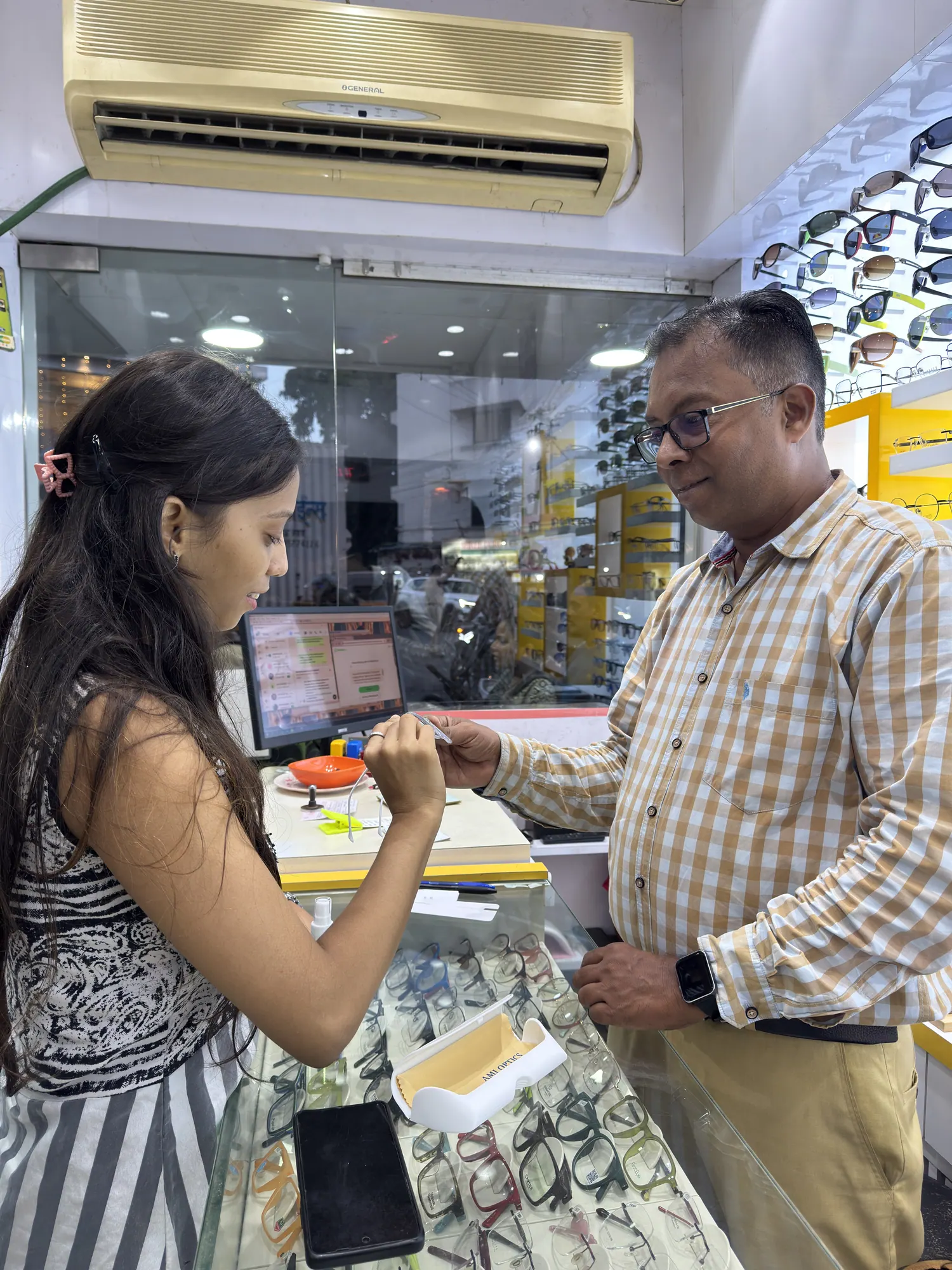
We start with what you are here for: a first pair, a spare, a work pair, something for a wedding. Then a handful of frames from the wall, not the whole wall. You try them in daylight at the door, and we tell you honestly which suits you, including when the cheaper one is the better choice.
Then the fitting: width, bridge, temples, and the measurements your lens needs. Take your time. Customers have been choosing frames here since 1996, and nobody has ever been hurried.
Questions people ask
How do I know which frame suits my face?
Find your face shape in a mirror (round, oval, square, heart, diamond or oblong), pick a frame shape that contrasts with it, then check the fit: as wide as your face, eyebrows visible above the frame, and the bridge resting flat without pinching. The quickest way is still to try a few on with someone honest beside you.
Which glasses suit a round face?
Rectangular or angular frames that add definition, in a width that matches the face. Avoid small round frames that repeat the face's curve.
Which glasses suit a square face?
Round or oval frames that soften the jaw. Avoid boxy frames with sharp corners.
Is it different for men and women?
The face-shape logic is the same for everyone. What differs is usually size and styling: men often need a wider frame for a broader face, and many women choose lighter or cat-eye shapes. Pick by your face and your fit, not by the section of the shop.
Does face shape really matter when choosing frames?
It helps narrow the choice, but fit matters more: width, bridge, eyebrows visible and temples level. A well-fitted frame in the 'wrong' shape beats a badly fitted one in the 'right' shape.
Can I wear any frame with a strong prescription?
Not comfortably. Strong minus powers look thick in large frames, and strong plus powers magnify the eyes. Smaller, rounder lenses and high index material help; ask us before you settle on a frame.
Not sure what applies to you? Ask us. A computerised eye test at the shop takes about 15 to 30 minutes, and we explain what we find in plain language.
This guide is general information from an optician, not medical advice. Sudden changes in vision, pain, flashes or a curtain over part of your sight need an eye doctor (ophthalmologist) straight away.
Find us
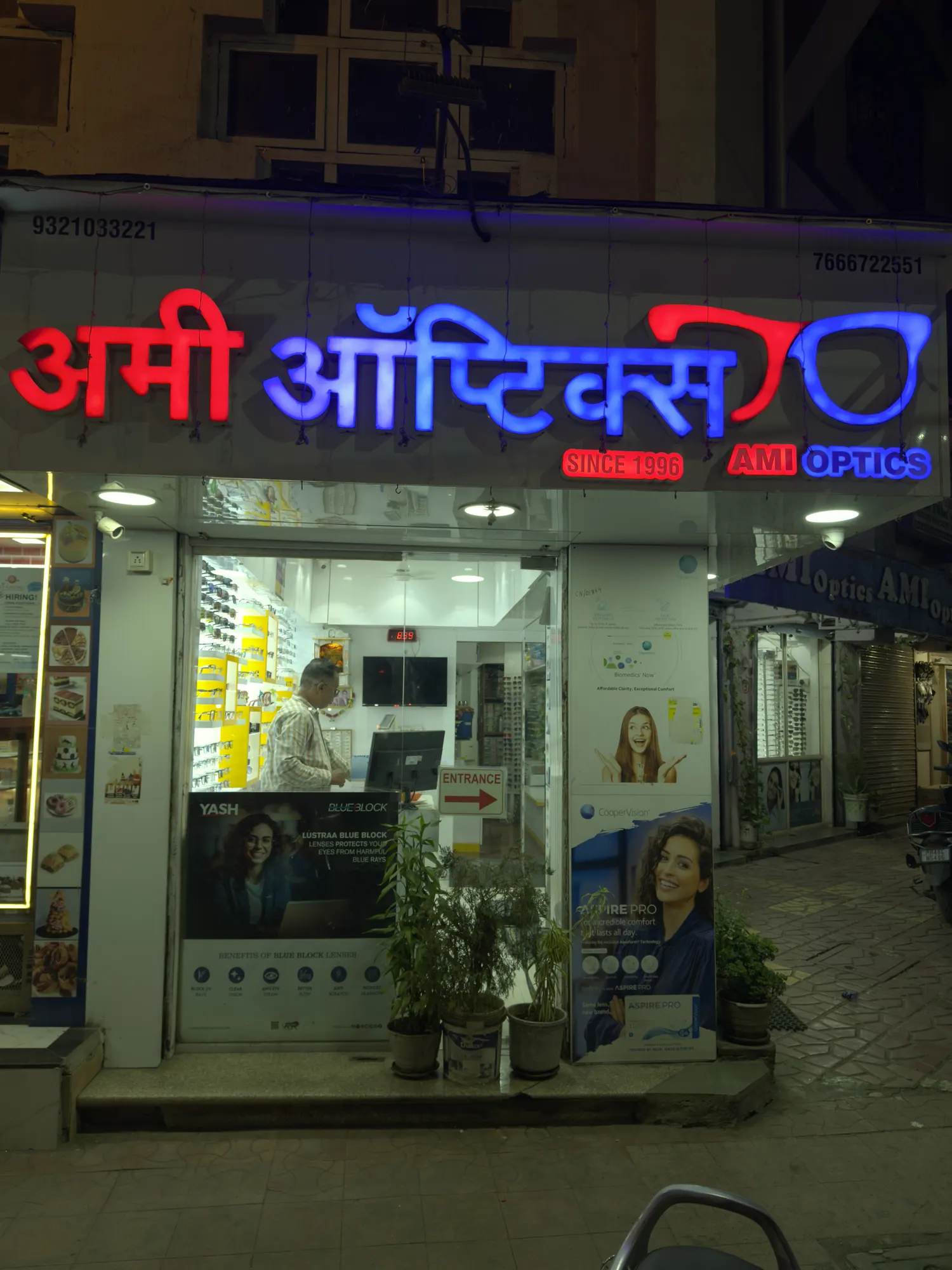
Near Sai Baba Mandir, at Jivdani Chowk.
Reading is a good start. A test is better. Walk in for a computerised eye test; no appointment is needed.
Address
Ami OpticsShop No. 1, Mohan Apt., V. S. Marg
Near Sai Baba Mandir, Opp. Radha Krishna Restaurant
Virar (E), Maharashtra 401305
Hours
Mon–Thu, Sat–Sun · 9:30 am – 9:30 pm
Friday · closed
Customers come to us from Virar East, Virar West, Nalasopara and Vasai. Look for the shop opposite Radha Krishna Restaurant, near Sai Baba Mandir, at Jivdani Chowk. Landmarks and a map are on the visit us page. We speak English, हिंदी and मराठी.
Keep reading
Related guides and services
Frame collections
Metal, acetate, rimless, titanium, gold finish, clip-on and smart glasses, photographed in the shop.
Read moreSpectacles
Frames, lenses and fitting under one roof, often ready the same day.
Read moreProgressive vs bifocal lenses
How each one works, who suits which, and what adapting is really like.
Read moreThe Lens Lab
Blue cut, progressive, photochromic, high index, anti glare and polarised, each with a working demo.
Read more
Let's help you see the world clearly.
Walk in for an eye test, browse the frames, or just say hello on WhatsApp. We'd love to meet you.